Home / Services / Danger Trees
The specialty
Danger Tree
Assessment & Falling
The leaning one. The dead one. The one that's been sitting there for three winters and everyone has quietly stopped parking under. Assessed properly, then put on the ground where it's supposed to go.
Most companies that will “take a look at your tree” are guessing. A dangerous tree is a defined thing in British Columbia, and assessing one is a regulated activity with a specific training requirement behind it.
What the regulation says
“A tree that is a hazard to a worker due to (a) its location or lean, (b) its physical damage, (c) overhead conditions, (d) deterioration of its limbs, stem or root system, or (e) any combination of the conditions in paragraphs (a) to (d).” WorkSafeBC OHS Regulation s. 26.1
Section 26.11 is the operative one. If a worker is going to be exposed to a dangerous tree, the employer either fells it or has a risk assessment done by a person who has completed a training program acceptable to the Board, and the recommendations have to be implemented before the work starts.
WorkSafeBC names the accepted programs. For forestry operations it's the Wildlife/Danger Tree Assessor course, coordinated by the Wildlife Tree Committee of BC and delivered through UNBC. There is a separate module specifically for Wildland Fire Safety, covering burned and fire-weakened trees, which fail on a completely different pattern from green timber.
That is the module he holds. Alongside his BC Forest Safety Council faller certification and Level 3 occupational first aid, and on top of being certified by the BC Wildfire Service to instruct the S-100 course. See the tickets.
What you get
- A walk of the tree and everything around it. Lean, location, stem condition, root collar, decay indicators, overhead hazards, what's in every possible fall path.
- A written finding. What's wrong with it, how urgent it is, and what we recommend. Sometimes that's “take it down.” Sometimes it's “this one's fine, but those three behind it aren't.”
- A method, in writing, before anything starts. Conventional fall, sectional takedown, rigged down in pieces, and what protects the shop, the fence, the septic field and the power line while it happens.
- The falling itself. By a certified faller, working to written safe work practices, with the equipment the job actually needs.
- Cleanup as agreed. Hauled, chipped, or bucked and stacked. Decided before we start, not negotiated after.
The trees we get called for
- Leaners over structures: houses, shops, cabins, decks, bunkhouses
- Beetle-killed pine: standing dead lodgepole with no strength left in the stem
- Fire-killed and fire-weakened trees: burned root collars, heat-checked stems, no lean to read
- Root-rot and butt-rot trees: the damage is underground and invisible from the deck
- Storm-damaged and hung-up trees: the most dangerous thing on any property, and the one most people try to deal with themselves
- Trees on lake-lot slopes: where there's nowhere for it to go but down the bank or into the neighbour's
- Trees near power lines: we coordinate with BC Hydro; we don't improvise around energised conductors
The insurance argument nobody makes
A tree that comes down in a windstorm is an act of God, and your insurer treats it that way. A tree that had been visibly dead for two years and came down in a windstorm is something else, and they treat that differently.
A written danger tree assessment does two jobs at once. It tells you what's actually wrong with the tree, and it puts a date on the page. If you've been meaning to deal with a tree for three years and haven't, the paperwork is worth as much as the falling.
We're fallers, not insurance advisors. Talk to your broker about how your specific policy handles it.
Send a photo first
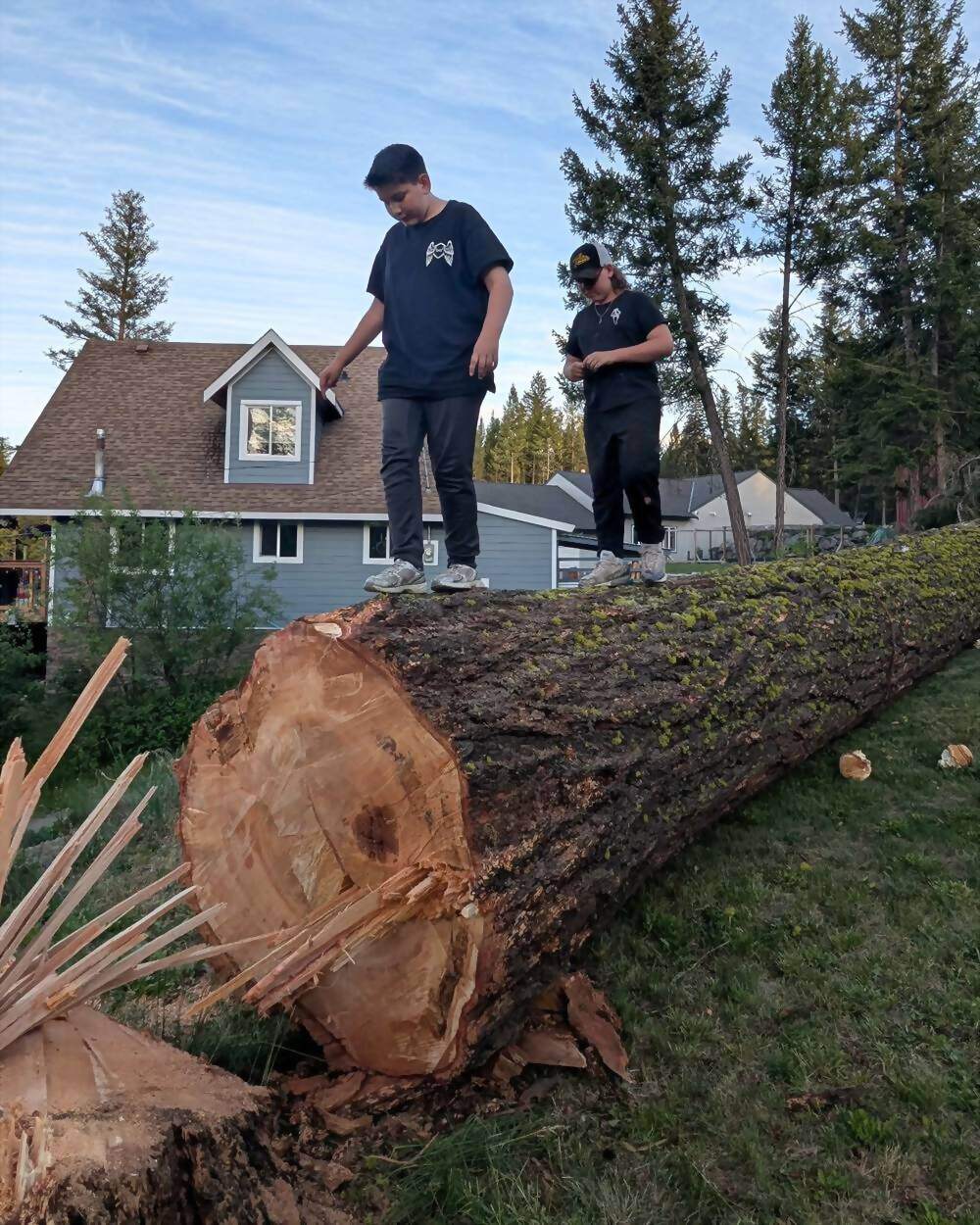
One frame with the tree and the house in it tells us more than a ten-minute phone call. Most jobs we can price or triage from photos before anyone drives out.
Upload PhotosHung-up tree? Stop.
A tree that's fallen and lodged in another is the single most dangerous thing on a rural property. Don't cut the holding tree. Don't pull it with a truck. Rope off the area and call.
Call (250) 945-9319Questions
Danger trees, answered.
What makes a tree a “danger tree”?
Do I legally need an assessment on my own property?
What does an assessment actually involve?
Can you take one down between two houses?
What about fire-killed trees?
Not sure if it's actually dangerous?
That's what the free assessment is for. Half the time the tree people worry about is fine and the one behind it isn't.