Home / Services / FireSmart
Fuel mitigation
FireSmart Vegetation
Management
Some trees you don't take down. You manage them. Home Ignition Zone thinning, ladder fuel removal and crown spacing, by a crew that spends fire season on the line.
There are seven FireSmart disciplines. Six of them belong to governments, fire departments and planners. One of them is contractor work: vegetation management, the reduction of wildland fuels to lower the intensity and impact of a fire. That's the one we do.
The Home Ignition Zone, three zones, not four
BC remodelled this. The old fourth zone out to 100 metres was dropped, because radiant heat is unlikely to ignite a structure past 30 metres. If somebody is still showing you a four-zone diagram, their information is out of date, and so, probably, is the rest of their advice.
Immediate Zone, 0 to 1.5 metres
The most vulnerable ground you own, and the cheapest to fix. Cleared to mineral soil or gravel. No woody plants, no bark mulch, no cedar or juniper against the siding, no firewood on the deck, nothing combustible under the stairs. This is where embers land and sit.
Intermediate Zone, 1.5 to 10 metres
Fire-resistant plantings only. Woody debris, slash and heavy needle litter cleared. Firewood piles, fuel cans, spare lumber and combustible storage relocated outside the zone. The test is simple: could a fire in this zone carry itself to the wall?
Extended Zone, 10 to 30 metres
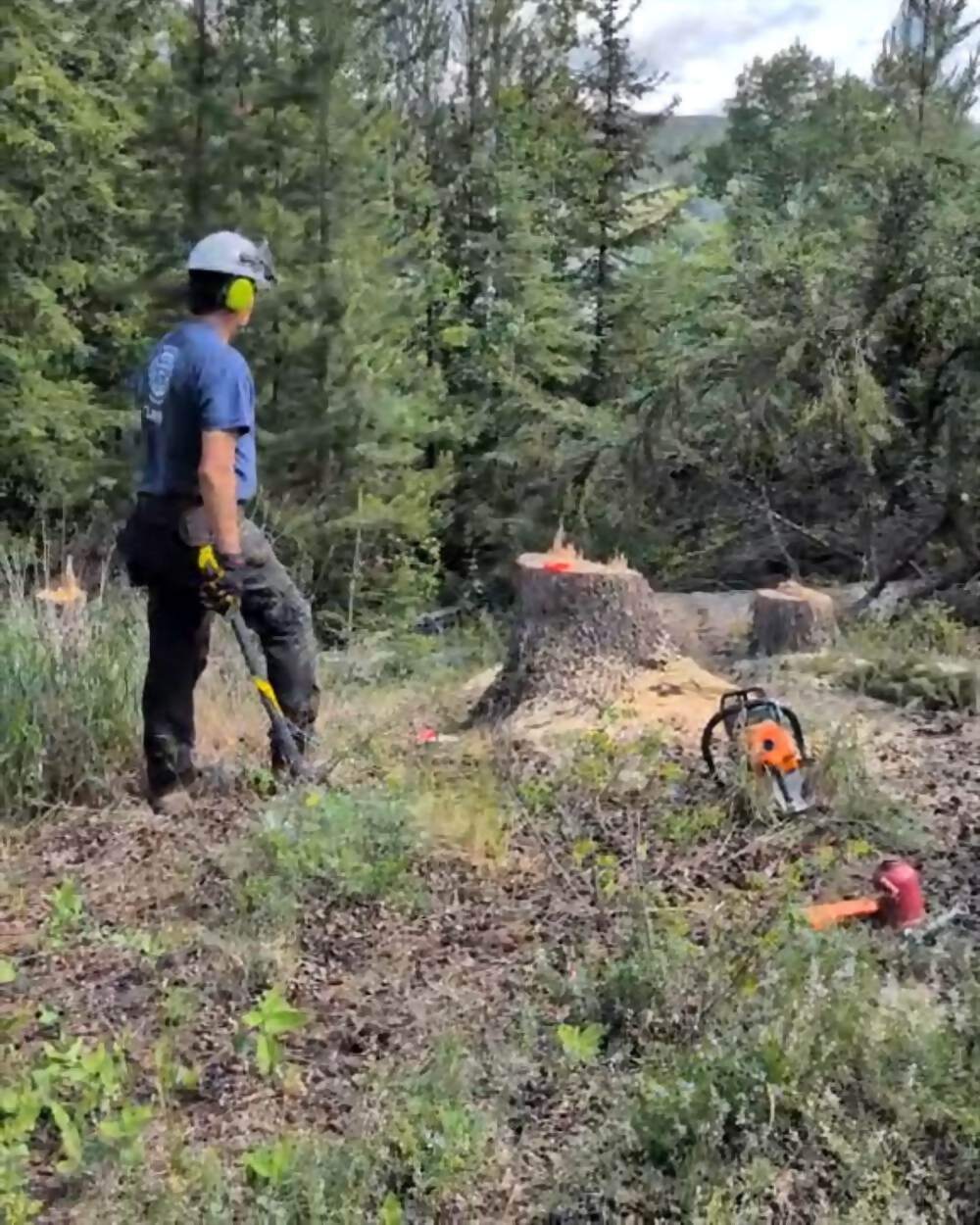
This is where the saw work happens. Selective conifer removal to open horizontal spacing between crowns. Lower branches pruned to two metres to break the ladder from the surface into the canopy. Fallen and dead material cleared. The aim isn't a bare lot, it's to drop a crown fire down onto the ground before it reaches the Intermediate Zone.
What we actually do out there
- Conifer thinning and crown spacing through the Extended Zone
- Ladder fuel removal: limbing to 2m, removing understorey conifers and regen
- Surface fuel reduction: dead and down material, slash, heavy litter
- Beetle-killed and dead standing removal: the Cariboo's specific problem
- Immediate Zone clearing back to mineral soil or gravel
- Chipping, hauling and disposal of everything generated
- Maintenance passes: because regrowth undoes this in a few seasons
Why the Cariboo specifically
The District of 100 Mile House Community Wildfire Resiliency Plan, finalised in October 2025, covers 2,655 hectares of eligible wildland-urban interface. 37.4% of that is private land, outside anything the municipality can treat directly. Portions of the interface are rated High and Extreme by the Provincial Strategic Threat Analysis.
The fuel types are ours: mature lodgepole pine, Douglas-fir-dominated stands, mixed conifer typical of the Cariboo Plateau, and beetle-killed stands carrying hazardous fuel loads that have been building for two decades.
The District has formally documented a problem it cannot legally solve, because the problem is on your side of the property line.
Free tipping in three towns
The Cariboo Regional District waives tipping fees on vegetative debris in Lac La Hache, 108 Mile Ranch and Lone Butte. If your property is in one of those, disposal cost on a FireSmart job drops to the haul. That's a real number off a real quote and we'll pass it straight through.
Get the free assessment first
The District of 100 Mile House and the CRD both send a qualified rep out at no charge. Take the report. Then bring it to us and we'll quote off it, line by line.
District of 100 Mile House FireSmart: (250) 395-2434
CRD FireSmart Educator: (250) 392-3351
90% of losses start as embers
Not a wall of flame, embers, landing in the first metre and a half. Which is why the cheapest work on your property is also the most effective.
Questions
FireSmart, answered.
Is FireSmart work the same as clearcutting my yard?
How much of this can I do myself?
Do I need an assessment before you start?
Is there a rebate?
How often does this need doing?
Book a FireSmart walk-through.
We'll walk the property with you, zone by zone, and tell you what actually matters, including the parts you can do yourself for nothing.